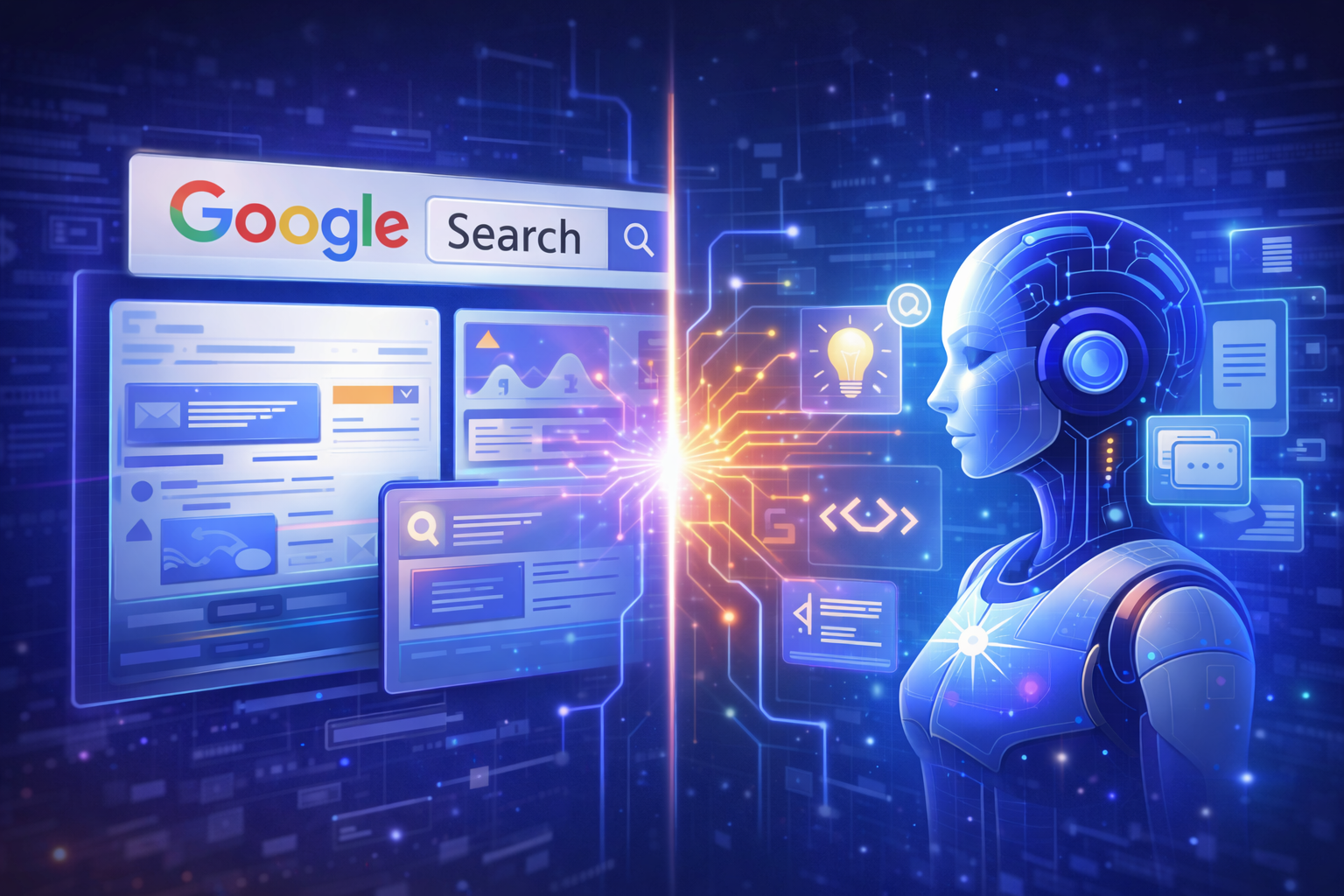
Artificial intelligence is rapidly transforming how people interact with search engines. Google has been integrating advanced AI technologies into its ecosystem, especially with the development of Gemini, its powerful AI assistant.
However, an important question has emerged within the digital marketing and search industry: Will Google Search and Gemini eventually merge into a single experience, or will they continue to evolve as separate products?
Recent insights from Google’s leadership suggest that the future is still uncertain. The direction of these technologies could significantly reshape how users search for information and how businesses approach SEO and digital marketing strategies.
Understanding Google Search vs. Gemini
Although both Google Search and Gemini use advanced artificial intelligence, they serve different purposes within the Google ecosystem.
According to Google’s Head of Search, Liz Reid, the two products have different goals and user experiences.
Google Search
Google Search is primarily designed to help users discover information across the web. Its main goal is to connect people with relevant websites, content creators, and online resources.
Search focuses on:
- Finding information across the internet
- Connecting users to websites and publishers
- Showing multiple sources and viewpoints
- Supporting discovery and exploration
In simple terms, Google Search acts as a gateway to the web.
Gemini AI
Gemini, on the other hand, is designed as an AI assistant focused on productivity and creative tasks.
Its core capabilities include:
- Generating responses to complex questions
- Helping with writing, coding, and brainstorming
- Performing productivity tasks
- Acting as a conversational assistant
Gemini behaves more like a digital assistant, rather than a tool for exploring the open web.
Could Google Search and Gemini Merge?
During a recent discussion, Google’s leadership acknowledged that the future relationship between Search and Gemini is still evolving.
When asked whether the two products might eventually merge, Liz Reid stated that even Google does not yet know the final direction.
Some possibilities include:
1. Full Convergence
Google Search and Gemini could gradually combine into a unified platform that blends traditional search results with AI-generated answers.
This would create a hybrid experience where users receive:
- AI-generated summaries
- Direct answers
- Links to web sources
- Interactive assistance
2. Continued Separation
Another possibility is that the two platforms continue to serve distinct roles.
In this scenario:
- Google Search remains the main tool for discovering information on the web.
- Gemini evolves as a productivity-focused AI assistant similar to tools like ChatGPT.
3. A Completely New Product
There is also the possibility that Google could eventually create a new AI-powered product that replaces or merges both systems.
As AI technology advances, Google may develop entirely new search experiences built around intelligent agents and automated interactions.
The Role of AI Agents in the Future Internet
One of the most interesting predictions from Google’s leadership is the rise of AI agents interacting with each other online.
Instead of humans manually searching the web, AI agents may increasingly perform tasks such as:
- Researching information
- Comparing products
- Booking services
- Communicating with other AI systems
This could lead to a future where much of the internet interaction happens between AI systems rather than directly between humans and websites.
For businesses and marketers, this change could significantly affect how content is discovered and consumed online.
What This Means for SEO and Digital Marketing
The potential convergence of Search and AI assistants introduces new challenges and opportunities for digital marketers.
Here are some key implications.
1. AI-Powered Search Experiences Will Expand
Google has already begun integrating AI capabilities into search results through features such as AI-generated answers and AI search modes.
As these technologies improve, search engines may rely more on AI to interpret complex queries and generate detailed responses.
2. Content Quality Will Become Even More Important
AI systems rely heavily on high-quality content sources when generating answers.
Websites that provide:
- Expert insights
- Original research
- Clear explanations
- Reliable information
are more likely to be referenced or cited by AI-powered search systems.
3. SEO May Shift Toward Answer Optimization
Traditional SEO focuses on ranking webpages in search results. However, AI-driven search introduces a new concept known as Answer Engine Optimization (AEO).
In this model, content is optimized to appear in:
- AI-generated answers
- conversational responses
- automated summaries
This means businesses must adapt their SEO strategies to ensure their content remains visible in an AI-first search landscape.
4. Website Traffic Patterns May Change
If AI systems begin answering more questions directly within search interfaces, users may visit fewer individual websites.
However, Google has also suggested that AI search experiences can encourage users to explore deeper queries and continue researching topics.
This means traffic may become more targeted rather than simply larger in volume.
The Bigger Picture: AI Is Reshaping Search
The discussion around Search and Gemini highlights a larger shift happening across the internet.
Search engines are evolving from simple link directories into intelligent assistants capable of understanding context, intent, and complex tasks.
This transformation will likely change:
- How people find information
- How businesses attract customers
- How websites generate traffic
For marketers, staying informed about these changes will be essential for long-term success.
Final Thoughts
The relationship between Google Search and Gemini remains uncertain. They may eventually converge into a single platform, evolve separately, or even be replaced by a new AI-driven experience.
What is clear, however, is that artificial intelligence will play a central role in the future of search.
Businesses, content creators, and marketers who adapt early to this evolving landscape will be better positioned to maintain visibility and competitiveness in the next generation of search technology.
Disclaimer
This article is created for informational and educational purposes based on publicly available industry insights and news sources. Technology platforms and search engine features may evolve over time, and readers should refer to official announcements and documentation for the most accurate and up-to-date information.
For more digital marketing insights, SEO strategies, and industry updates, visit:
https://adifydigitalmarketing.com/